Is the Terminal Too Accessible for Me?
- 5 minsWritten by me, edited with robot assistance.
For a long time, Terminal felt like home.
I lived in Vim. Tmux. fastlane. Git. SSH. A growing collection of shell scripts that only made sense to me. It wasn’t just where I wrote code. It was my workspace.
I loved it.
For me, the terminal was calm.
No menus. No buttons. Nothing between me and the problem I was trying to solve.
Looking back, though, I think there was another reason I loved it.
It had just enough friction.
Not frustrating friction. Healthy friction.
Every new idea required a little bit of intention. Create a directory. Name a file. Wire things together. Open another tmux pane. Even if those steps only took a few seconds, they forced me to pause.
“Is this worth starting?”
I don’t think I realized how valuable that tiny pause was until recently.
Earlier this year I was diagnosed with autism and ADHD.
I wrote about that whole journey in my last post.
That diagnosis answered a lot of questions, but it also changed how I look at the way I live and work.
For a long time, I thought my biggest challenge was simply making it through the day without becoming overwhelmed.
I was constantly overstimulated.
By the time I sat down to work, a surprising amount of my energy had already been spent regulating myself. Noise. Context switching. Meetings. Notifications. Life.
Over the last several months I’ve been intentionally building systems to help with that.
I’m protecting my mornings more.
I’m paying attention to sensory overload instead of trying to push through it.
I’m finding routines that actually leave me feeling regulated instead of exhausted.
I haven’t figured it all out (I definitely haven’t), but I’ve made more progress than I expected.
I genuinely feel healthier.
I thought that would basically solve everything.
Instead, it just revealed the next problem.
When my brain isn’t spending all of its energy trying to stay regulated…
It runs.
Every idea feels exciting.
Every project sounds fun.
Every rabbit hole feels worth exploring.
And then AI showed up.
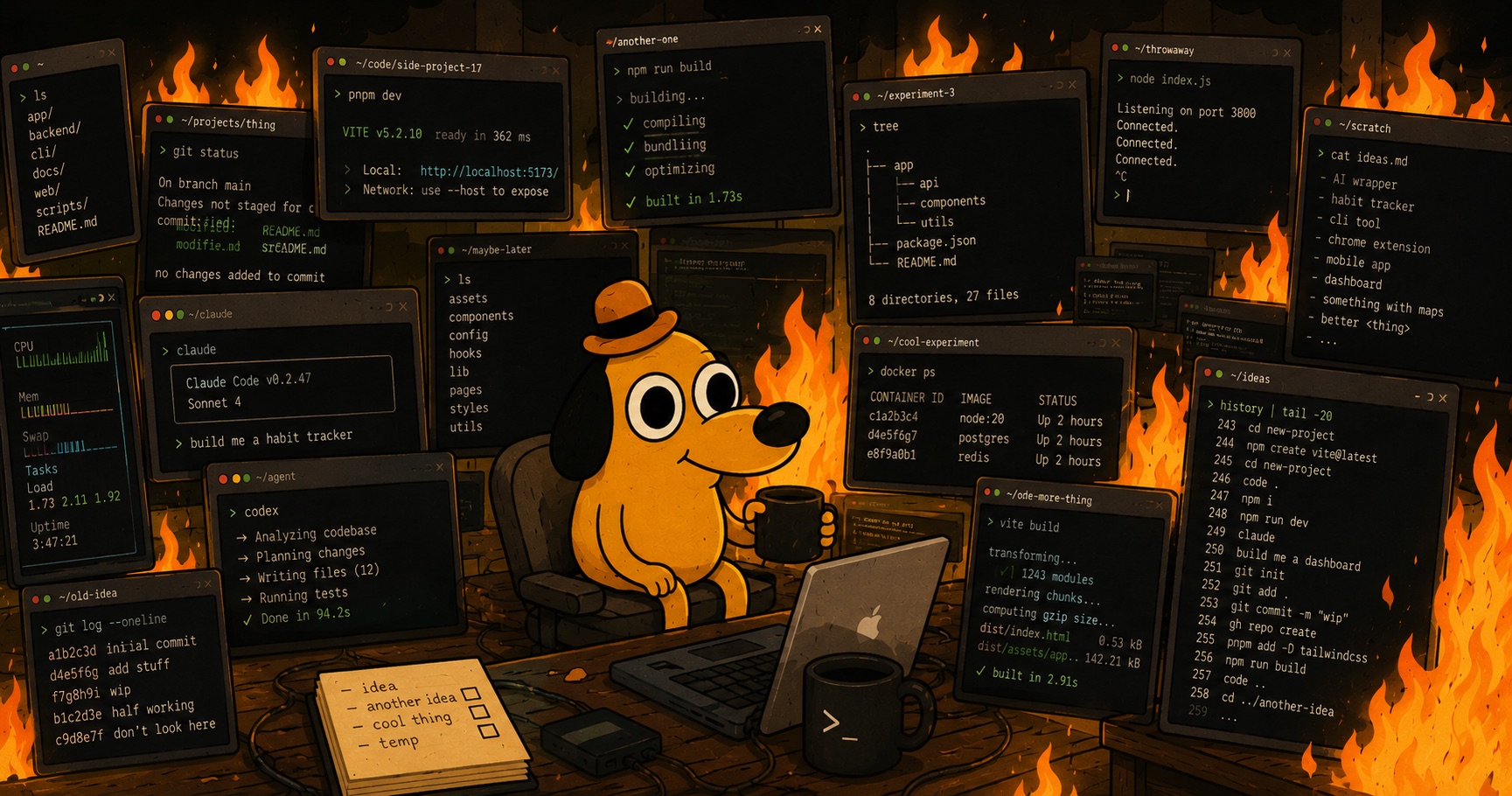
My terminal still looks almost exactly the same.
But it feels completely different.
Claude Code.
Codex.
Agents.
Instead of engineering something piece by piece, I can talk through an entire idea and watch a whole project appear.
Need a prototype?
Five minutes.
Curious about another approach?
Sure.
Want to spin up an entirely different idea before lunch?
Why not?
The cost of starting something new has almost disappeared.
And I think that’s exposing something about me that I never had to think about before.
I don’t think AI is making me less productive.
I think it’s removing one of the guardrails I didn’t know I relied on.
The terminal used to slow me down just enough.
Not because it was difficult.
Because it required intention.
Nothing appeared unless I went and made it appear.
Nothing was ever in my face.
AI removes almost all of that.
Now everything is one sentence away, always sitting right in front of me.
"Now everything is one sentence away, always sitting right in front of me."
Now my brain can move at the speed of my curiosity.
That sounds amazing.
Sometimes it is.
But curiosity has never been the thing slowing me down.
My attention has.
Where it goes. What holds it. Whether I can come back to something after the excitement wears off.
Starting barely asks anything of me now. It’s just a paragraph typed to a robot.
But the work that actually matters still needs my full attention. The IDE. The simulator. The browser. Actually reading the PR and looking at what got built.
And that part hasn’t gotten any cheaper.
What’s been most surprising is that I don’t think this is really a technology problem.
It’s a me problem.
Or maybe a workflow problem.
For years, I thought my bottleneck was overstimulation.
So I worked on it.
And it worked.
Now I can finally see the bottleneck that was hiding behind it.
It turns out I don’t really have an idea problem.
I have an attention problem.
The ideas were never the scarce part. My attention was.
"The ideas were never the scarce part. My attention was."
What I actually need is help deciding where to point it.
The healthier I’ve become, the easier it is for my brain to chase every interesting thought.
AI is an incredible amplifier for that.
Lately I’ve been wondering if I need to intentionally add some friction back into my life.
Not enough to slow me down.
Just enough to make me think.
Mental speed bumps.
Maybe that’s writing ideas in a notebook before opening a new terminal.
Maybe it’s merging one branch before I start another.
Maybe it’s asking myself one simple question before I prompt an agent.
“Am I starting this because it’s important… or because it’s effortless?”
I’m still figuring that out.
The irony isn’t lost on me.
For most of my career I’ve been trying to remove every ounce of friction from software development.
Now I’m wondering if I accidentally removed some of the friction that was helping me focus.
Maybe the goal isn’t to eliminate friction entirely.
Maybe the goal is to choose which friction is worth keeping.
Because AI made starting almost effortless.
Now I have to figure out how to bring all of that into this new way of working.
Focusing. Polishing. Maintaining. Making things clear.
None of that ever felt like the hard part.
The code was the friction, and it quietly set the pace for everything else.
"The code was the friction, and it quietly set the pace for everything else."
Now I have to find that pace myself.
And I don’t think that’s a decision I can just make once.
It feels more like getting back into shape.
Retraining my brain a little at a time until the new pace actually sticks.
